
Culture Club
I might be alone here, but I love kimchi! I know about the reported benefits of good bacteria for our gut and that’s a complete bonus but I actually really like the taste as well. So… I decided to make it. The recipe I used was surprisingly simple and not too many ingredients or fiddly steps and as a first foray into the world of fermented food, it was an excellent and successful start
A few notes to start. I used a recipe from the BBC food website but I also added a couple of ingredients that I had seen on other recipes because I am a hopeless meddler and can never just do what I am told. It’s probably completely wrong for purists out there and I hope I haven’t offended anyone. I am not trying to make any claims of higher knowledge but just wanted to experiment.
I ordered my korean chilli flakes online and just another note, the recipe stated that the radishes should be mooli, or Chinese radish, but as I didn’t have any I used regular radishes.
Anyway, here is the recipe I used and I hope you enjoy it too. Give it a go. You might be pleasantly surprised and even if you aren’t, your gut might be! My husband commented that if he saw it at the back of the fridge and didn’t know what it was he would probably throw it out! What a Cheek! He still ate it.
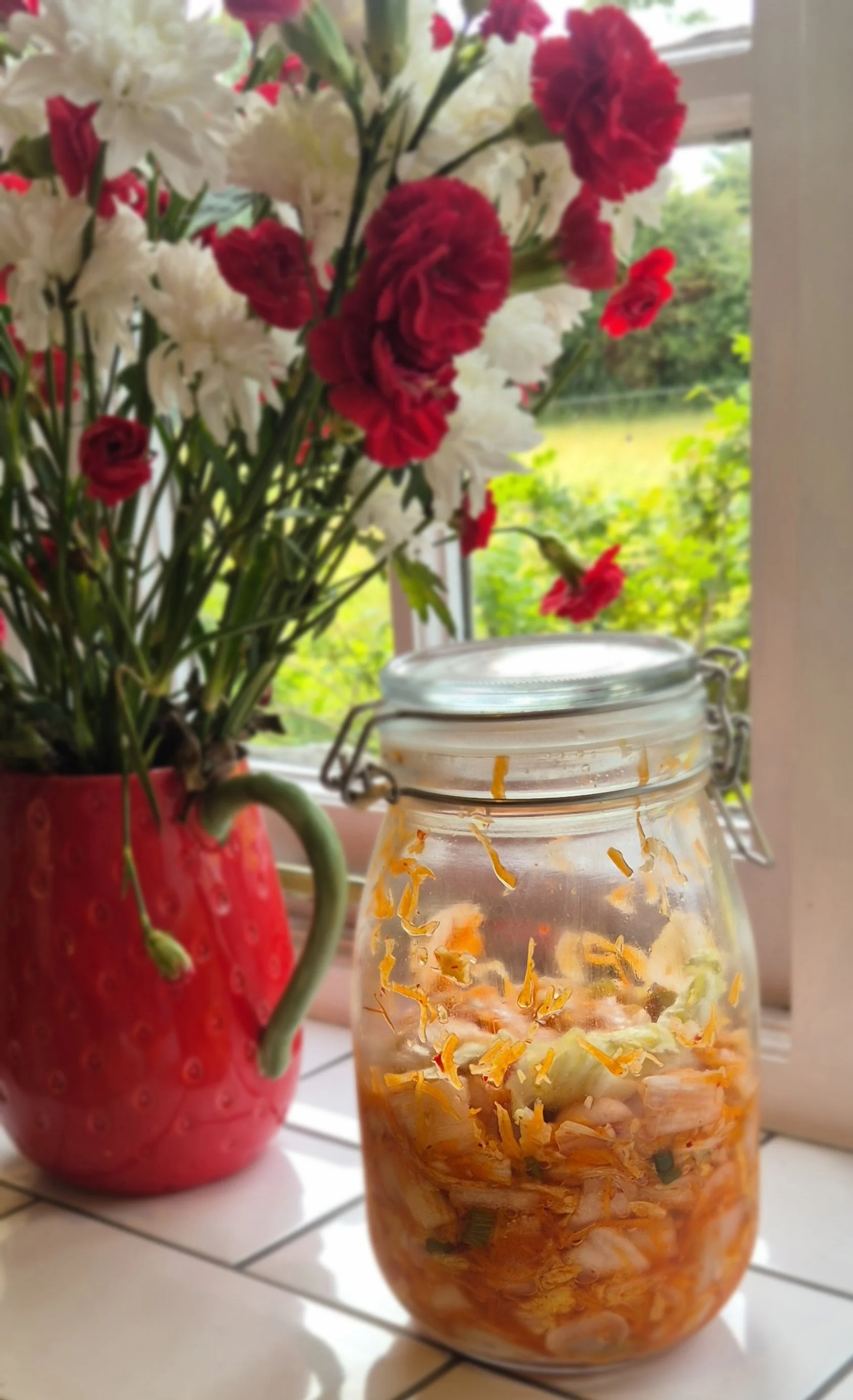
1 large chinese cabbage, quartered and sliced into 1inch thick slices
grated carrot, about one cup
150g thinly sliced radishes,
4-6 garlic cloves thinly sliced
20g fresh ginger peeled and roughly chopped
20g gochugaru ( Korean Chilli flakes)
6 spring onions
a few drops of korean fish sauce
a splash of rice wine vinegar
METHOD
Wash your equipment thoroughly in warm soapy water, then rinse well under very hot water and leave to air dry.
Put the cabbage in the clean mixing bowl and separate using your fingers. Arrange in layers, with a little salt sprinkled between each layer. Cover the bowl with a plate and leave to stand for 2–3 hours. The cabbage will soften and become limp, and should be sitting in a pool of water when you return to it. It will have reduced in volume by about a third.
Drain the salted cabbage in the clean colander, then return to the bowl. Cover with cold filtered water and swirl the cabbage around, then set aside to soak for 10 minutes. Drain in the colander and return to the bowl. The cabbage should taste slightly salty.
In a blender or pestle and mortar, grind the garlic, ginger and chilli flakes to a paste.
Add the radishes, spring onion and carrot to the cabbage and tip in the chilli paste. This is where I added a really small amount of fish sauce and rice wine vinegar. Wearing disposable, or clean, new, rubber gloves (to protect your hands from the chilli) thoroughly massage the paste into the vegetables. You can do this with a spoon, but it is less effective.
Spoon the cabbage mixture into the clean jar until it comes up to just under the top of the jar. There is no need to pack it too tightly but you don’t want too much air to reach the surface of the vegetables. To prevent this, place the cabbage leaf over the top of the mixture and press down genrly. Cover with the lid and fasten securely.
Leave in a cool, dark place at room temperature (around 18–20C) for 2–3 days. If your room is warmer, the kimchi will ferment more quickly. Taste the kimchi. If it tastes spicy, sour and slightly cheesy with a good umami flavour, it can be transferred to the fridge to slow down the fermentation process.
In particularly warm weather, you may see small bubbles appearing in the kimchi, which shows the vegetables are creating the lactic acid needed to preserve them. Even in the fridge, you may need to ‘burp’ the container to release the gas after a few days.
You can begin to eat your kimchi right away, but it will continue to ripen and become more fully flavoured the longer it is fermented. You’ll get to know which degree of flavour you prefer. If you are dipping in regularly, you may inadvertently introduce other bacteria to the jar, so it's best consumed within a week or two.
